
Lakecia Benjamin speaks candidly about performing, inspiration, discovering the sax, and coming back from voice surgery
“I Just Hope That They See Me”
Lakecia Benjamin talked her way into her first saxophone in a middle-school hallway. Six Grammy nominations later, the New York alto player, arranger, composer and educator has built a catalog that keeps reaching for its elders and pulling them into the room with her: Retox (2012), Rise Up (2018), Pursuance: The Coltranes (2020), Phoenix (2023), produced by drummer Terri Lyne Carrington and carrying the voices of Angela Davis and Sonia Sanchez, its live companion Phoenix Reimagined (2024), and now We Dream (2026). She spoke with us in late August, a month after a voice surgery that doctors thought might take her speaking voice for good. She is funny, blunt, and almost impossible to flatter.
Interview by Ricard Torres-Mateluna, Journalist, Northampton Jazz Festival Board Member, Papeles de Jazz Magazine (Chile) Editorial Board Member and North American Correspondent, Member of the Jazz Journalists Association and Vice-president of Marketing and Communications at Viability.org
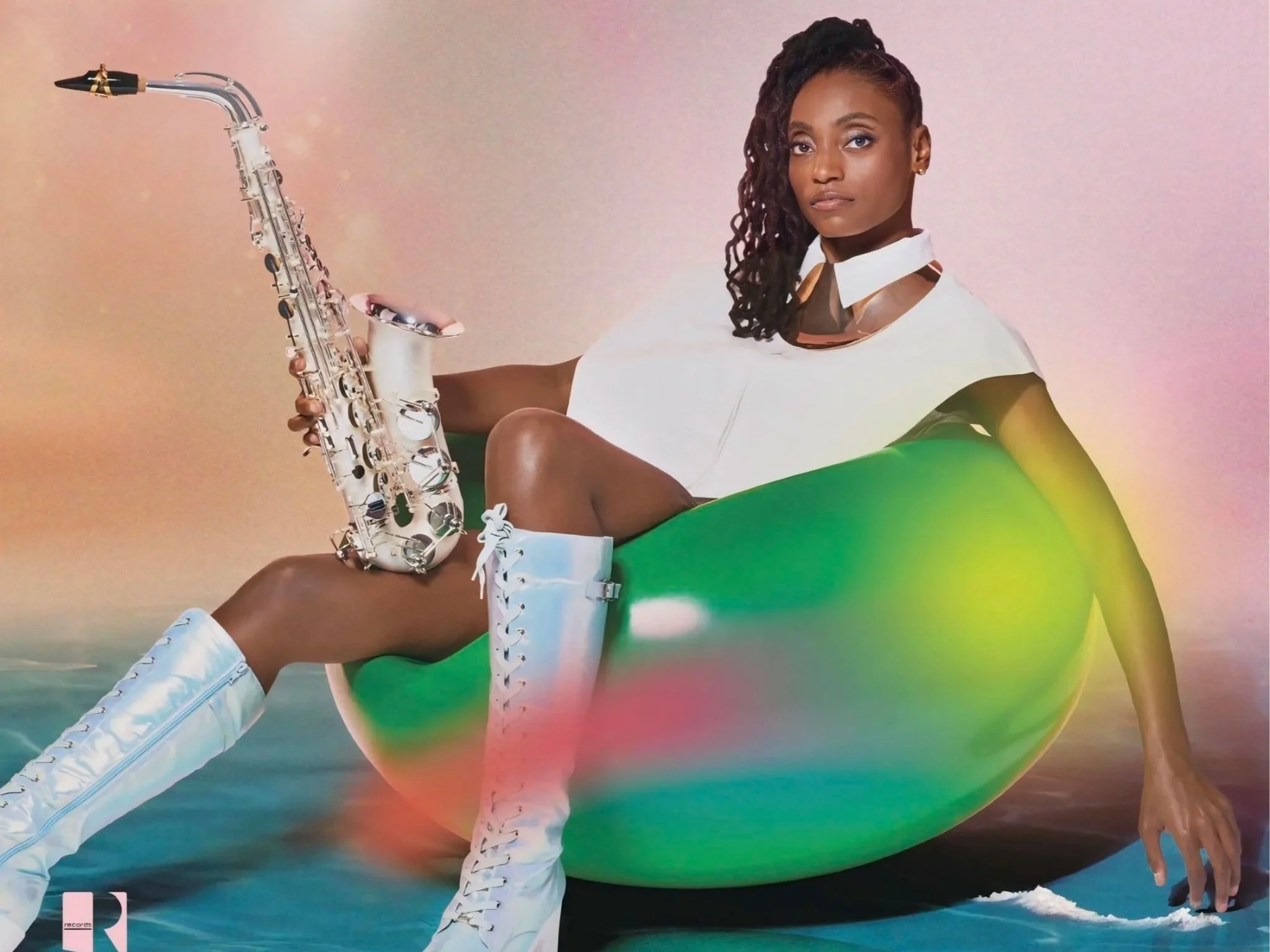
Lakecia Benjamin, photo credit: Elizabeth Leitzell
A sweet trade!
Take us to the room. The first time you heard a saxophone and thought, that!
That has never, ever happened. I’m so sorry. I never saw a saxophone player and said, oh yeah, I want to do that.
So how did you decide to play?
I was in school, and they had to put us in chorus, band, or art. I instinctively knew chorus is probably not the way. I went to art, and I had a good time there, I thought it was a good idea. Then I went to the band room, and they were having, I wouldn’t say a rehearsal, but like a jam session, everybody rehearsing. I spoke to the music teacher, and they had all the instruments hanging on the wall.
So I was looking around and saying, oh yeah, can I pick one? He was like, yeah, what would you like? And I chose the alto saxophone, and he told me there are no saxophones available. And I was like, oh, wow. So he showed me some trombones, drums and stuff, and explained things, and I was like, I’m not really into it.
So what did you do?
I asked him to tell me who the saxophone players were, and I knew all of them. So I went and spoke to them one by one. The two boys said they like the saxophone, they’re not gonna go to art. The last one was a girl, and I asked her if she liked playing the saxophone. She said it was okay.
So I said, okay, so just okay? Would you like to be in art? She said, that sounds okay. So I said, listen, I have like four Oreos in my pocket. If you just hand me the sax right now, I’ll take it and you can go to art. And I told her what time the class was, and we switched.
Alice, then John
You seem to have come at a lot of things sideways. With Pursuance you spent time learning the music of both John and Alice Coltrane. Which one did you come to first?
Alice. I knew Alice’s music better than John. I learned her music first. Always. I was going through the liner notes, and she said something like, all praise to John Coltrane. So I had to Google who John Coltrane was. I was assuming maybe a brother or something. And then I saw that he was her husband, and then I saw an extensive history of work going all the way down.
So you went back through him?
Because I’d already finished all of her albums that were recorded, I went through his albums, and I put them in chronological order. It took probably a couple of years, but by the time I got to the end of it, I really could no longer separate them.
Because I had already been familiar with her journey of how far she had gone, and now learning his journey, and then how they start to musically connect, I have always seen them as a duo. Because I would not know one without the other.
Forty-five minutes
You came up around Rashied Ali, Clark Terry and Reggie Workman. Is there a phrase from them that you repeat to other musicians?
No, there’s no custom sentence they gave me. Clark Terry did have a famous phrase. He said: “they see you before they hear you”. So I took that to mean always come dressed for the job.
And in our field, I also think that means you should show who you are before you even play a note, so people can continue the intrigue in who you are by listening, versus trying to figure it all out in one 90-minute setting.
And Rashied Ali?
He didn’t tell me anything special, but we had been rehearsing for such a long time when I first met him, and I didn’t know it was a rehearsal. Finally, at the end of it, he took the towel off the clock, and I said, why have you been. And he said, you played with me duo for 45 minutes. And I was like, I think you’re crazy, old man. I didn’t know he was Rashied Ali. I was like, why are we doing this?
He told me that when you first start playing, you play everything you want people to see. You play everything you’re really good at. And it’s only by wearing you down, when you have nothing left, that I find out who you really are. He said, so it took me 45 minutes to find out who you were. And that person I would like to help. And then he told me who he was. And it was pretty funny.
Under the fire
You came up through New York’s public arts schools and then The New School. What did that training give you that you still lean on?
One of the positive things The New School has is that a lot of their faculty are some of the older legends. So you get more of the old school stories and ideas, and you have a respect for them just coming in, because you already have seen what they’ve done.
So the advice that they give you is more also how to survive the streets of New York. They are telling you to go out, they’re telling you to go to places. Because you’re in New York, you’re going to jam sessions, you’re going to meet other people. And you’re kind of learning to deal with the fear of immersing yourself in a professional music environment right away, versus going to school and then later pursuing it.
So I think it gives a homegrown growth, a little bit more real life in the field, action-based, versus just the idea. If I had just gone to school, you don’t even think of it as a profession, you just think of it as, this is something I love to do. Versus this way, you’re doing something you love to do with other people. Under the fire.
Some of that fire was other people’s stages. Before the records under your own name, you were in horn sections behind some of the biggest voices in pop and R&B. What do you learn standing a few feet from someone like that about where the beat actually lives?
I have never learned where the beat lives from the singer, unfortunately. I’ve actually been confused as to where it lives. But I have learned in the different settings with different environments, jazz versus pop versus the type of star you are. Like Clark Terry, he still commanded a lot of attention.
I think when you watch someone lead a show, you start to learn and put yourself in that situation. How would I lead if I had the opportunity? Some crowds are hostile, some crowds are nice, some crowds are really quiet. How do they break them in? What techniques do they use? How does Stevie Wonder talk to 100,000 people versus 100? How does Prince talk to all these people? When he strips it down to just a guitar and he’s singing, how does he command 10,000 people to be quiet and listen to this?
And what did you take from watching that?
Is it a funny show? Are they using banter? Are they using humor? All of these things show their personalities and their particular style, but it forces you to take what you think works for you and quickly figure out, especially as a horn player these days. I feel like horn players mostly just play the show and leave. And they forget that there’s an entertainment thing too, where the audience is coming for your story, and they’re looking for you to tell it.
A lot of times you’re hoping that people can get that story through the music, and they cannot unless they’re superfans. So I think they always taught me to respect the audience. And respect that the fans are dying to get to know more about you, and they’re just begging you to tell them.
Building the room around the guest
Angela Davis’s voice on Phoenix stays with people long after the record ends. Did the music come first and make room for her, or did you build around what she brought?
For every album, every guest that I have, the need for them is tailor made. If I want Sonia Sanchez, I have designed the album around what she does. If I want Angela Davis, I’ve designed the song and the context to be around the artist, so that nobody has to come in and adjust themselves to me.
We are adjusting to their skill set. We don’t ask Meshell Ndegeocello to play and then she has to lower herself to us. She stays at her level, and we have to rise up to the occasion. That, to me, is the ultimate way you can get mentorship.
So when I find my guests, I’m looking to create pieces around them, but I’m also looking to keep mentors forever. I’m hoping that the relationship will stay, and that you will go from someone that has become a collaborator, to a teacher, to a friend, to a colleague. I’m hoping to earn your respect through the process. I only pick people that I seek mentorship out. There used to be an older way of doing it, but these days you have to kind of manufacture it in the beginning, because everyone is so hidden since the COVID world.
And Angela Davis in particular?
This is the first time I had an album with all female guests, besides Wayne [Shorter], and I wanted someone to announce the women with the royalty they should be in. And there’s only certain people where you hear their voice and you know right away that’s them.
For me, with all of my studies in college on Angela Davis’s works, all the books I read about her, all the marches I have seen, her voice is so iconic in my head. And the fact that she was also friends with those women that are on the project, and they had had intimate relationships in terms of friendships and knew each other. I thought there was no more of an iconic voice to not only introduce them and welcome them.
But just the sound of her voice can often, even if I don’t have social justice ideas in my head, force the listener to reevaluate the context of the sirens, to reevaluate the context of the gunshots, to cause them to say, does Lakecia mean the world is in shambles right now because of political warfare, or does she mean to evoke her accident? Was she hearing sirens then, when the ambulance came to get her? So it will make the message more universal.
The umbrella
Drummer Terri Lyne Carrington produced Phoenix, and you have grown into the bandleader role over the years. What have you learned about leading a band that no one could have taught you in school?
That the band wants to get paid. I thought they would just show up for fun.
I guess the biggest thing I’ve learned, being in the front, is that people cannot remove me from any situation. So I always think of myself as a musician first, and an artist, and a businessperson, of course. But the whole world is seeing me first as a Black woman. They’re seeing me as a woman. All of these things are coming into it, and that’s society, the type of bandleader people are seeing me as. So I didn’t realize that there would be any bias in there.
I didn’t realize how many roles I would have to take. That I would have to be, in the beginning, the manager, the booking agent, the songwriter, an excellent performer. I would have to introduce the show, I would have to make the business cards, make the websites. I think there are a lot of roles that bandleader goes in. It’s like bandleader, then an umbrella of things that doesn’t get seen. That requires you to almost grow up in a way. And to really believe in yourself and your independence.
You make it sound less like a job than a stamina test.
I didn’t think it was so much of a psychological game. I thought it was just do what you love and have fun. And now I’m realizing there’s a mental stamina. If you’re going to make it your, whatever, 50, 60 years in the business, there is a way you’re going to have to keep finding out who you are and identifying who you are and becoming so vulnerable to your audience, that you keep being willing to tell your story through the low points and the high points. And you have to tell it authentically, otherwise they will not gravitate to it, because they will see that it’s manufactured.
The hour before
What is the hour before downbeat actually like?
They all come so fast these days. But every show I do, there is anxiety there. It’s not like, oh yeah, another show. They all still have the same anxiety I felt when I was 12 years old playing in a school auditorium.
I always have some kind of nervousness, because I realize I’m engaging new energy. And I’m almost surrendering myself to the crowd to say, I have my program scheduled, but if at any moment I feel that this needs to go another way, I am willing to do what’s needed. Because I’m here to present my music, of course, and my art, but my music and art is in service of the audience.
So I will change what I have programmed, or what I think they need. If I think they need me to be louder, I’ll be louder. If I think they need me to bring it down, I’ll bring it down. So I always start with my true self. Before I go on stage, I always do a little prayer of gratitude for even just the gift of music and having the opportunity.
But I really go out there and let the audience know, this is all I have. If this is the last show, anybody who writes about it will know, yeah, this definitely is worthy of a last show. So I always give everything I have, to the quiet ones and the interactive ones. And I just hope that they see me.
September, Northampton
What should people expect when you hit the stage here, whether they own every record or are walking in to see you for the first time?
If it’s the first time, I’m always upbeat, positive. I’m just a little bit of an energizer bunny. I’m always dressed for the occasion, for sure. And I like a lot of bright metallic colors, people know about me, especially my gold.
But I think for these shows, the last month I have been on a little bit of an unanticipated break, because I had a voice surgery where they thought I probably wouldn’t talk again. And I somehow have managed to recover, and you are the first interview that I’m doing.
I think these September shows are gonna be very emotional for me. I’ll be coming straight from the Hollywood Bowl to the Festival. I think I will have more gratitude with me.
Two more
We’re booking our 2027 headliner and honestly don’t know yet who it will be. What would you want us to ask them?
You gotta put somebody out there, brother! The way the world is going, I would ask them, especially if they’re older than me: in these times, what do you think an artist can do to preserve their integrity, their mental health, but also to elevate people’s spirits in these times?
And one for yourself, ten years out?
I don’t even know if I would have a question. I would just probably be like, how are we still here? Every time I do an album, something crazy happens to me, so hopefully. I would imagine I’d maybe stop making albums, I don’t know. I don’t have any question I would ask her.
But I would just try to remind her to fight through as much fear as possible.
